Best Harness for Dachshunds: What Worked for Ours
Finding a harness that properly fits the sausage dog body can be surprisingly difficult. When we first got Rocky, we didn’t realise quite how much trial and error would be involved.
Dachshunds have an unusual shape, with a long body, deep chest and short legs, and we found that harnesses designed for dogs more generally didn’t always sit where they should. Some were too loose in one place and tight in another, while others rubbed or gaped as he walked.
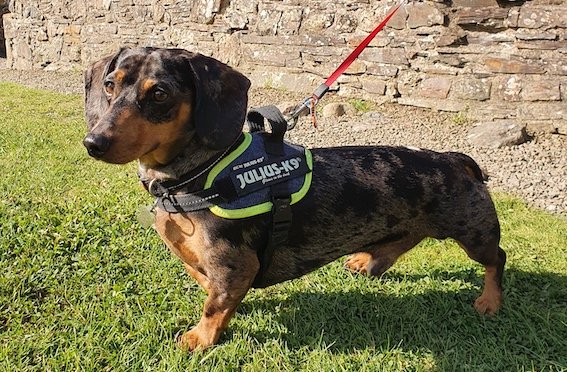
After trying several different harnesses over the years, the one we’ve had the most success with is the Julius K9 IDC® Powerharness. In fact, we’ve now been using the same one for more than four years.
Why We Use a Harness
Some dachshund owners prefer walking their dog on a collar, but Rocky simply wouldn’t walk properly with one when he was younger.
We also weren’t particularly comfortable with the idea of him pulling against something around his neck. As dachshund owners we were already very conscious of looking after his back, so we decided fairly early on that we’d rather attach his lead to a harness.
For us, a harness also gives us better control of him when we’re somewhere busy or passing other dogs. That’s particularly useful with Rocky, who can be reactive towards dogs he doesn’t know.
That doesn’t necessarily mean every dachshund needs to be walked on a harness, but it’s what has worked best for us.
The dachshund harnesses we’ve tried
Our first harness: Pets at Home
We bought Rocky’s first harness from Pets at Home when he was a puppy. Even the smallest one we could find locally was slightly too big for him, but it did the job for those first few weeks of getting him used to walking on a lead.

He grew out of it pretty quickly, which started our search for something that fitted him a little better.
After trying several generic off-the-rack harnesses from different brands, we were beginning to wonder whether we’d need to have one made for him. We repeatedly had the same problem: one part would fit while another was either too tight, too loose or rubbing somewhere it shouldn’t.
3 Peaks adjustable harness
For a while we used a bright orange adjustable harness from 3 Peaks, which we also bought from Pets at Home.
This was better than some of the others we’d tried and had enough adjustment to accommodate a jumper underneath during winter. It still wasn’t quite right, though. Depending on how we adjusted it, we found it could either rub or gape in awkward places.
Julius K9 IDC® Powerharness: the one we stuck with
After asking other dachshund owners what they used, we decided to give the Julius K9 IDC® Powerharness a try.
We measured Rocky carefully using the manufacturer’s sizing guide and chose a Mini-Mini.

This ended up being the best fit of everything we’d tried. The chest and belly straps can be adjusted to fit him properly, it feels secure when we’re walking and it’s very easy to get on and off – particularly useful if your dachshund isn’t interested in standing still while you get them ready!
It was one of the more expensive harnesses we’d bought, but ours has now survived more than four years of regular use and is still going strong. Based on our experience, I’d happily buy another.
How to choose a harness for a dachshund
The biggest lesson we learned is not to rely on a harness being labelled Small, XS or even “for dachshunds”. There isn’t a standard size between brands, and dachshunds themselves vary considerably in build.
Measure your dog and use the size guide for the specific harness you’re considering.
For example, Julius K9 currently lists its Mini-Mini IDC Powerharness for dogs with a chest circumference of 40–53 cm and its Mini for 49–67 cm. That doesn’t mean a miniature dachshund automatically needs a Mini-Mini, though – use your dog’s actual measurements rather than their breed or weight alone.
When trying a harness, I’d look for:
- Enough adjustment to accommodate a dachshund’s deep chest without leaving other areas loose
- A secure fit that your dog can’t easily back out of
- Straps that don’t rub behind the front legs
- No obvious restriction of your dog’s normal movement
- Something that’s easy to put on and take off
- Padding or soft contact points where appropriate
Once it’s fitted, watch your dachshund walking in it rather than judging the fit while they’re standing still. Look for straps moving around, rubbing behind the legs or changing position as your dog walks.
Does my dachshund still need a collar?
If you’re in the UK, yes.
We walk Rocky using his harness, but he also wears a lightweight collar with his ID tag.
Under the Control of Dogs Order 1992, dogs on a highway or in a public place must, with limited exceptions, wear a collar showing the owner’s name and address, either on the collar itself or on a tag or plate attached to it.
We include a contact telephone number too. It’s not a replacement for having your dog microchipped, but it makes it much easier for someone to contact you quickly if your dog ever gets lost.
Dachshund harness FAQs
Is a harness better than a collar for a dachshund?
There isn’t one answer that will suit every dachshund. Some walk perfectly happily on a collar, while others, like Rocky, do much better with a harness.
We prefer using a harness because it means his lead isn’t attached directly to his collar and we find it gives us better control of him on walks.
Can dachshunds escape from harnesses?
They certainly can if the fit isn’t right! Their deep chest and relatively narrow body can make some harnesses surprisingly easy to wriggle backwards out of.
Whichever harness you choose, adjust it carefully and make sure your dachshund can’t easily reverse out of it before heading somewhere busy.
What size harness does a miniature dachshund need?
Don’t choose purely based on your dachshund being miniature or standard. Measure them and follow the sizing chart for the individual harness.
Rocky wears a Mini-Mini Julius K9 IDC Powerharness, but another dachshund may need a different size depending on their chest measurement and build.
How tight should a dachshund’s harness be?
It should be secure without digging in or restricting normal movement. Check the manufacturer’s fitting instructions for the harness you’re using and pay attention to how it sits when your dachshund is actually walking.
If you notice rubbing, redness, hair loss or a change in the way your dog moves while wearing it, the fit or style may not be right for them.
Our verdict
We’ve bought more dachshund harnesses than I expected to when we first brought Rocky home, but the Julius K9 IDC Powerharness is the one we’ve ultimately stuck with.
It fits him well, is quick to put on, feels secure on walks and, perhaps most impressively, ours has survived years of regular use.
That doesn’t mean it will be the perfect harness for every dachshund. Their proportions vary more than you might expect, so finding the right one can involve a bit of trial and error. But if you’re struggling with harnesses that gape, rub or simply don’t seem designed for the dachshund shape, it’s one I’d consider trying.